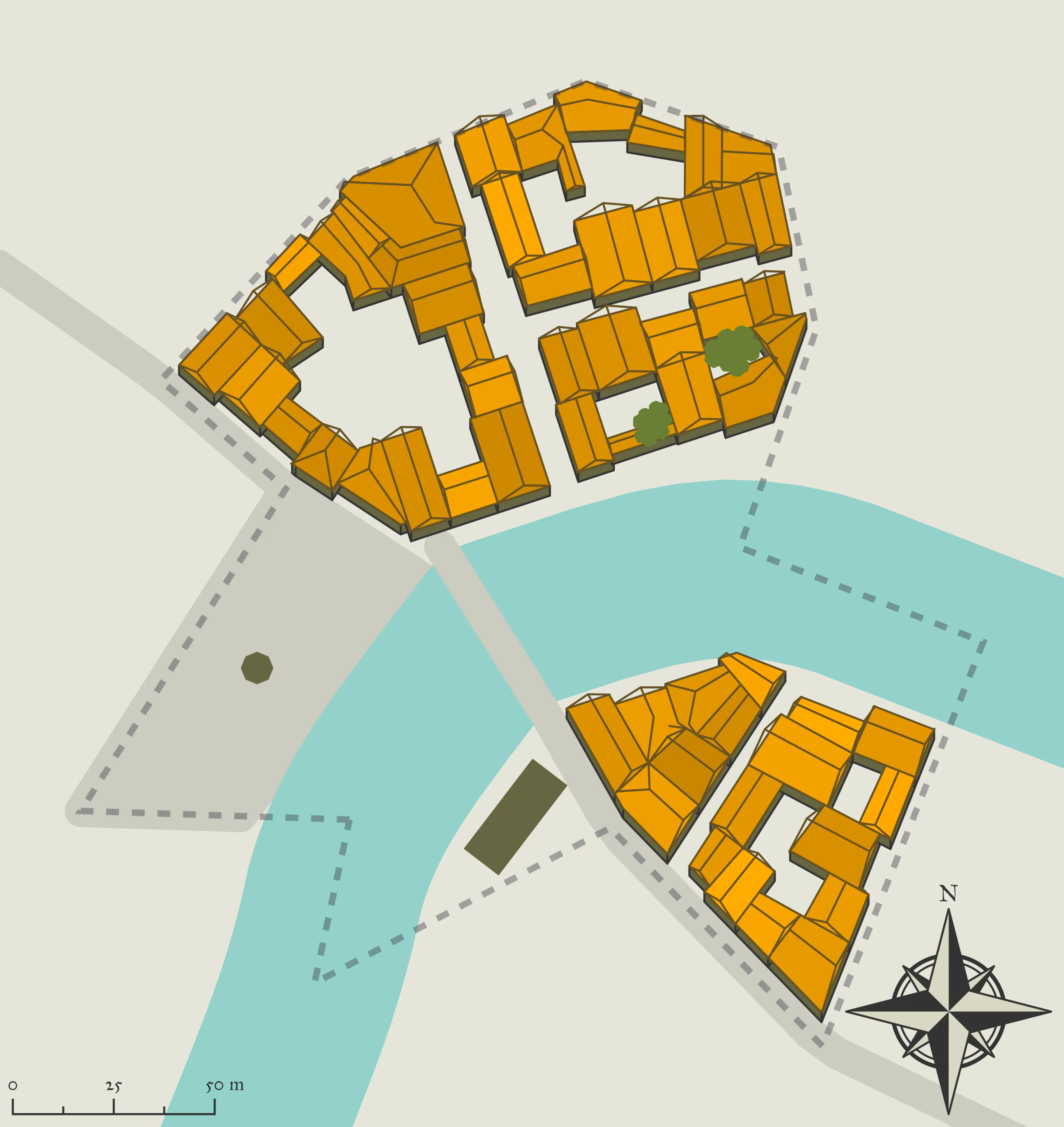
Wedged along the riverbank at the city’s centre, the Chrysalis Labs district is less a neighbourhood than an institution given its own territory. The research campus occupies a compact but architecturally imposing footprint—tall buildings of pale stone, glasshouses for experimental specimens, enclosed walkways connecting facilities, and gates that are politely but firmly staffed at all hours.
The Labs sit at the intersection of the river and the city’s two halves, which is both practical—river access for materials and waste management—and symbolic. Chrysalis Labs considers itself the hinge on which the city’s future turns. Whether the rest of the city agrees depends on who you ask.
Character: Clinical, ambitious, controlled
Notable features:
- Main research facilities (medicine, originium energy, structural biology)
- Medical complex (public-facing clinics and treatment wards, separate from experimental areas)
- Chrysalis University (founded and funded by the Labs; trains medical researchers, engineers, and sociologists)
- Secure storage and laboratory wings
- River landing for materials transport
Branches:
- Medical Section — investigates biological processes and effects of substances
- Energy Section — research into originium, geothermal, biothermal and solar energies
- Scientific Investigation Section — field explorers uncovering relics of Terra’s previous civilisations
- Structural Section — studies the basic particles of living beings and how they are affected by their environment
- Defense Section — handles security, laboratory emergencies, and classified information
- Engineering Section — mechanical and robotic support for researchers
- Business Section — public affairs and communication with other factions
- Human Resource Investigation Section — staffing and personnel
Current Speaker: Elis Kulf, who also serves as City Mayor—a concentration of power that Leonore of Alyss and others running in the election have made a central point of their campaigns.
Worship: There are no temples inside the Labs campus. The institution’s relationship with religion is politely formal—the Labs neither endorses nor discourages personal faith, but has little patience for theological explanations of phenomena it considers scientific in nature.