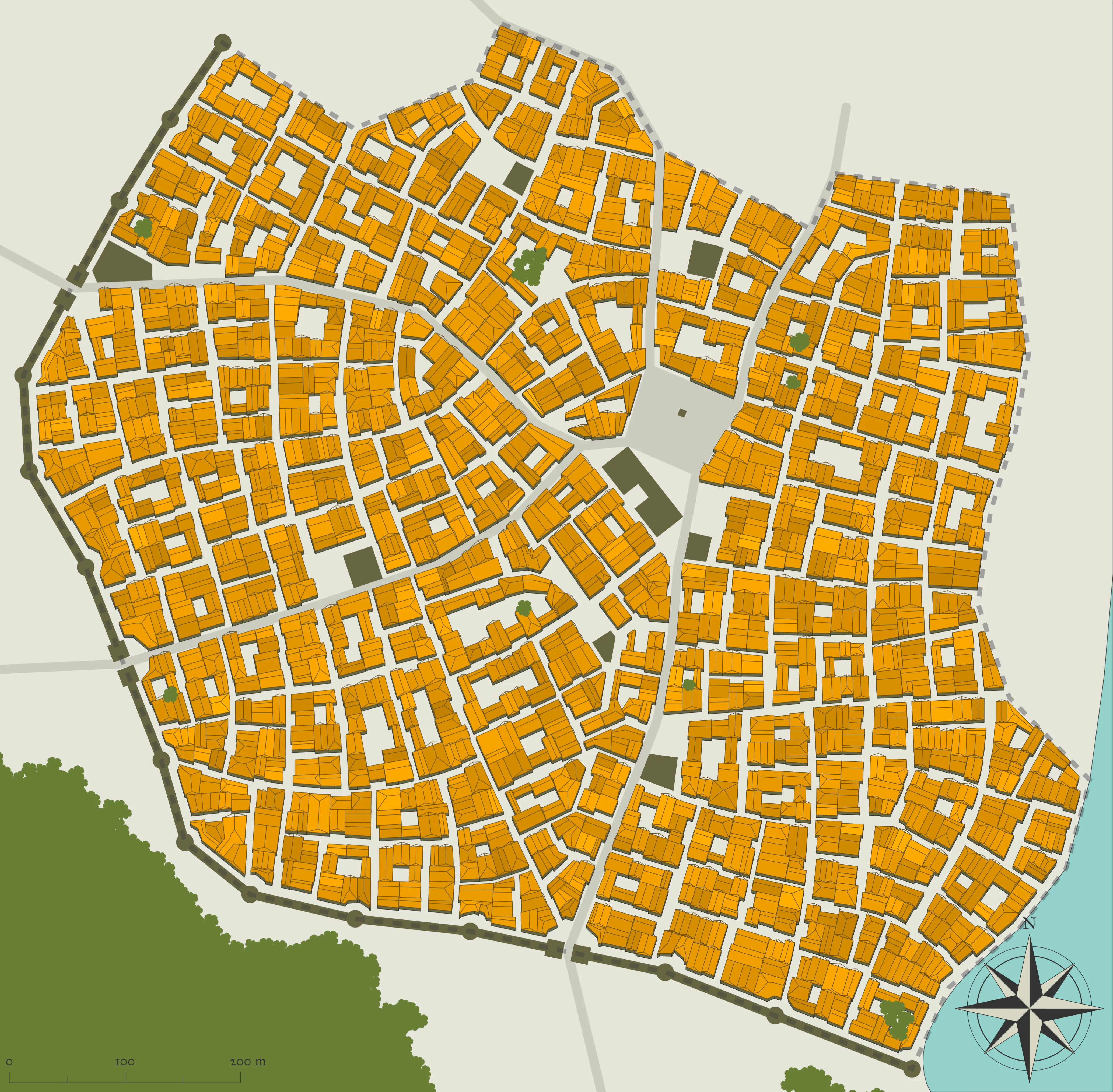
Lindenhall is Wien in miniature — its largest district by far, and the one that best captures the city’s obsession with art, music, and culture. Where Hofmark hoards its beauty behind gates, Lindenhall puts it in the street: buskers on every corner, workshops with their doors propped open so passersby can hear the instrument-makers at work, and a concert hall large enough to be the pride of the entire city. Middle-class families and working artisans make up most of Lindenhall’s population, giving the district an energy that’s less rarefied than Hofmark and less shadowed than Nachtmarkt.
At the district’s heart sits a central plaza, and beside it the Pantheon — a shared temple complex where all eight of Wien’s gods are given a place, side by side, regardless of how devoutly or lightly any one of them is actually worshipped day to day. Two street markets run off the plaza like spokes, one south toward the city gate and one west, keeping Lindenhall’s commerce and its faith within sight of each other.
Character: Vibrant, communal, unmistakably Wien
Notable features:
- The Leipzig - Wien’s largest concert hall and theatre, host to the city’s major performances
- The Pantheon — a shared temple to all eight gods, standing beside the central plaza
- South Street Market — running from the plaza to the southern gate
- West Street Market — running from the plaza to the western gate
Worship: The Pantheon is Wien’s most visible expression of faith — eight shrines under one roof, none formally ranked above another, though foot traffic tells its own story. Tymora’s shrine tends to draw performers and gamblers hoping for good fortune before a show or a wager; Boldrei’s sees steady traffic from Lindenhall’s many families. Valefor’s shrine is deliberately unassuming — fitting, for a god who prefers to be a question rather than an answer — while Lolth’s corner of the Pantheon is visited rarely, and mostly out of caution rather than devotion.
Population Character: Middle-class craftspeople, musicians, instrument-makers, performers, and market vendors. This is the district where a talented gnome fiddler and a tiefling noble’s third cousin are equally likely to be found — Lindenhall doesn’t care much who you were born as, only what you can make or perform.
Notes
- Worship details for individual gods’ shrines within the Pantheon are creative extrapolation, built on the divine relationships already established elsewhere (Tymora’s interest in Valefor, Valefor’s role as deliberate mystery, Lolth’s more fraught standing)
- Could be a natural home for a named concert hall or tavern drawing on the Schubert-style song titles already in your notes (Der Erlkönig, Gute Nacht, Der Leiermann, Der Wanderer) if you want a specific venue rather than just “the concert hall.”