Hurdy-gurdy notes drift from a tavern doorway and mix with the smell of woodsmoke and river mist. Tiefling nobles in high collars pass gnome street-musicians without a glance, while somewhere behind the old castle walls, this year’s crop of hopefuls disappears into the Labyrinth, chasing an empty throne.
City Overview
Wien is Terra’s city of art, music, and inherited melancholy, sitting on the far eastern side of Titania where the boreal forest gives way to a sheltered stretch of coastline. Where Chrysalis chases progress and Malachite chases ore, Wien chases beauty — and treats the succession of its throne as something to be earned through trial rather than blood.
Tieflings and gnomes make up the bulk of the population, with goliaths, firbolgs, minotaurs, and elves forming sizeable minority communities drawn by the city’s tolerance and its reputation as a place where a wanderer can make a name for themselves. The city’s aesthetic leans hard into German Romanticism — its people are preoccupied with the tension between civilization and the wild nature pressing in from the forest, and their art constantly returns to themes of wandering, loss, and inherited (often literally infernal) sorrow.
Emperor Witiges, ruler of Wien, is dying and without an heir. Rather than let the throne pass by blood, he struck a contract with the gods: whoever proves themselves worthy by conquering the Labyrinth built into the old castle by the shore will inherit his crown. This single decision defines the entire city right now — every noble, artist, and gutter charlatan has an opinion on who deserves to win, and the city has organized itself, physically and politically, around the Labyrinth’s presence. Nowhere is that more visible than in Hofmark, where the noble houses closest to the crown quietly jockey for position around Witiges’ own street, and where the Auction House does as much trading in political favor as in art.
Population: ~3,000–3,500 (estimate — not yet fixed in notes; adjust as needed)
Government: Emperor Witiges, though effectively a lame-duck ruler awaiting a successor from the Gauntlet. Day-to-day administration likely falls to Hofmark’s court functionaries and noble houses in his stead — the succession stakes make this a tense, closely watched arrangement rather than a stable regency.
Defense: An imperial guard tied to the castle and the Labyrinth complex, per the Labyrinth district notes — its exact jurisdiction over the rest of the city (versus a separate city watch) isn’t detailed yet.
Commerce: Art, music, performance, and instrument-making dominate, alongside originium-powered inventions — most visibly the light-up bricktile streets that make Wien’s nights safer to walk. Ufermark’s smiths and harbor trade, Weidenmark’s farms, and Nachtmarkt’s after-dark market round out an economy that runs on both beauty and practicality.
Geography & Layout
Based on the generated map: the forest meets the city along its southern edge and stretches west, while the coastline meets the city in the southeast. The castle — the entrance to the Labyrinth — sits near the shore and is walled off as its own fortress, integrated into the city wall itself.
- North/Northwest: farmland, feeding two outer districts, each with its own main road into the city.
- East: the shoreline and harbour maintained by a district.
- South/Southeast: shoreline and forest edge. An outer district is located here with its own main road into the city.
- West: Forest stretching from west and ends in the south. A single outer district sits there surrounded by the forest.
Districts
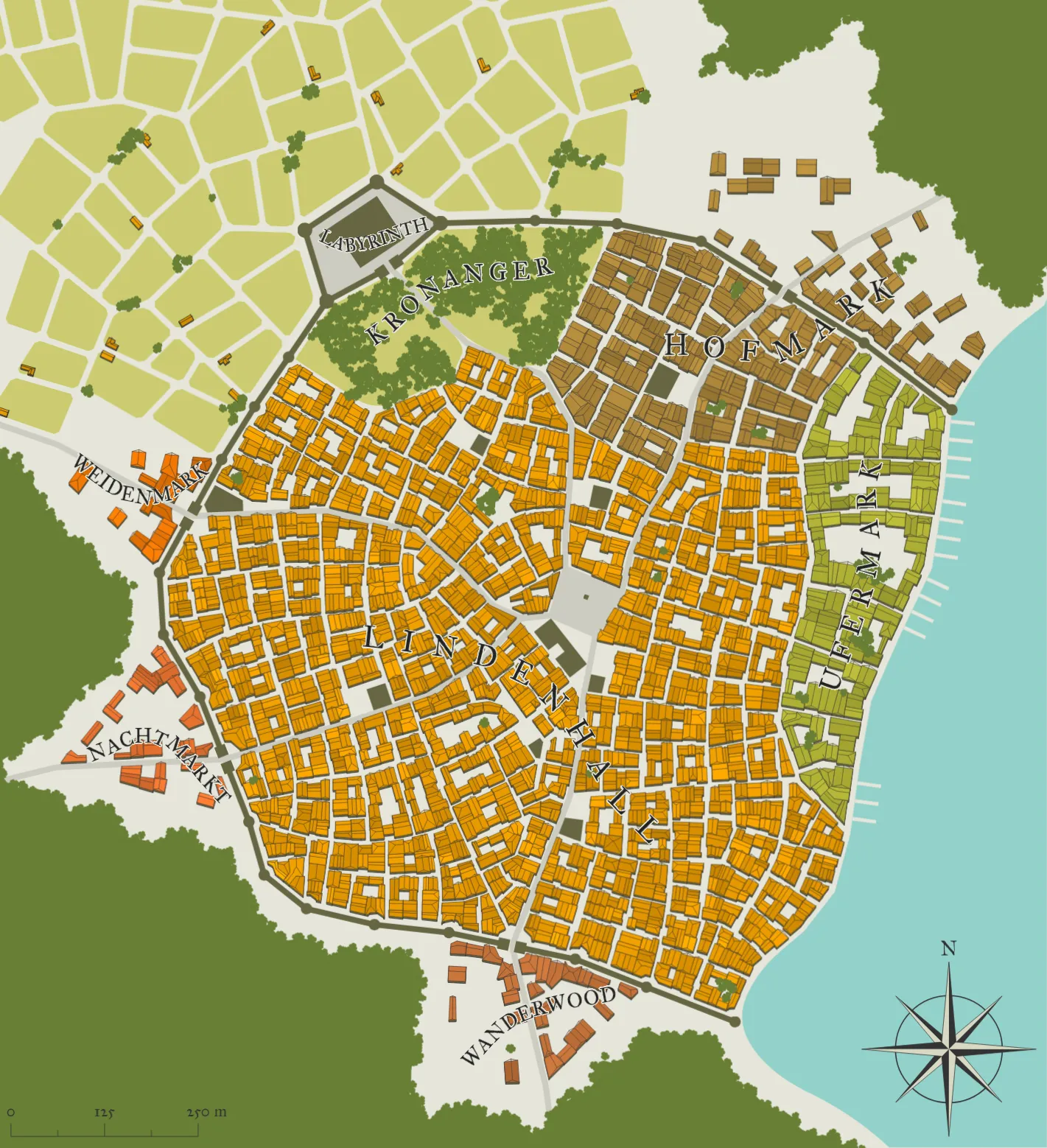
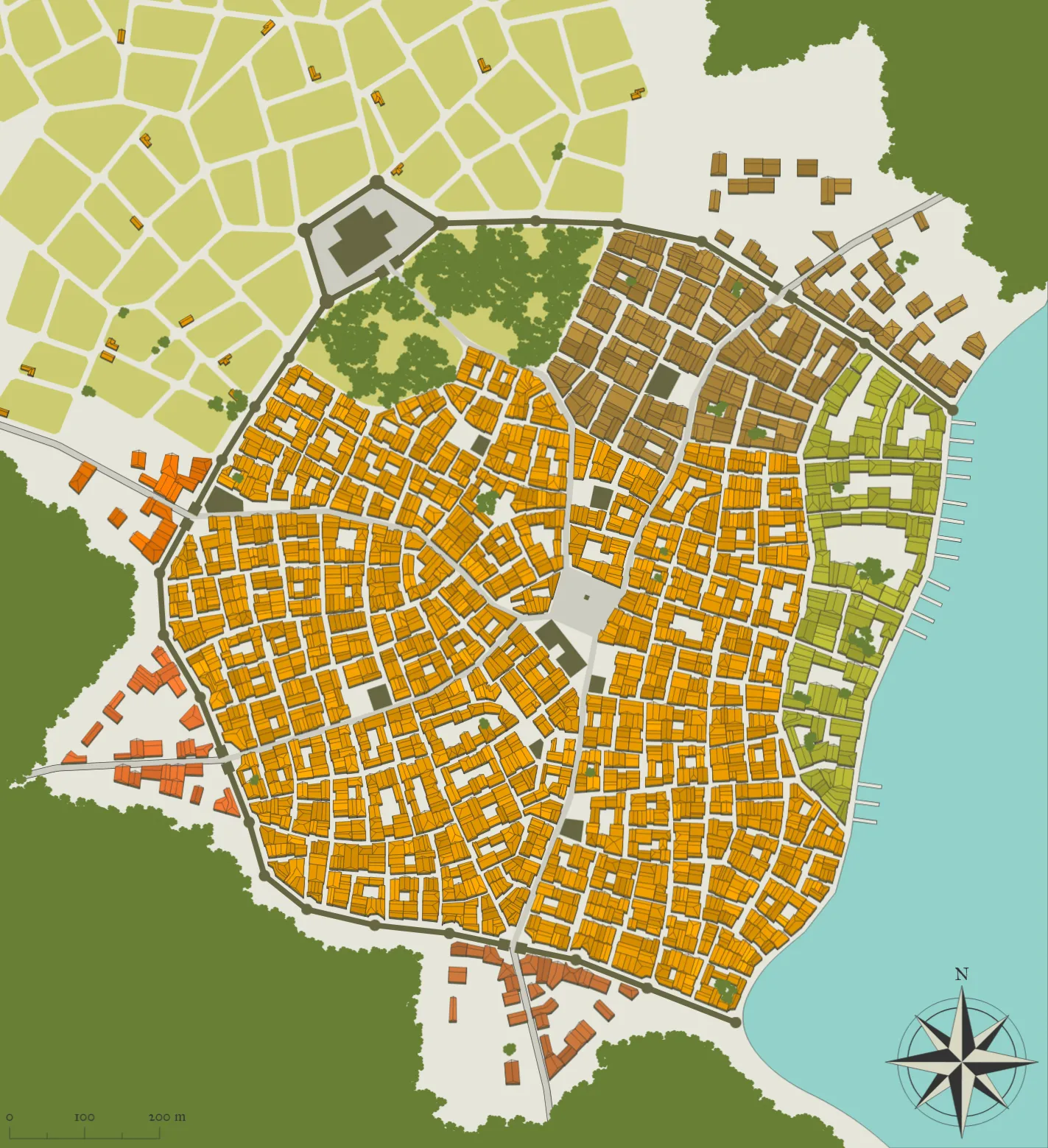
Outer Districts
- Weidenmark — farms and pasture, feeding the city from the north
- Nachtmarkt — the after-dark market, trading in goods that don’t circulate officially
- Wanderwood — forest-edge homes for hunters, foragers, and wanderers passing through
Inner Districts
- The Labyrinth of Wien — the castle-fortress housing the gods’ trials
- Kronanger — the park where challengers gather before entering
- Hofmark — Wien’s noble quarter, home to Witiges’ own street
- Lindenhall — the largest district, art, music, and the Pantheon of the eight gods
- Ufermark — the harbor and industrial quarter
Notable Locations
- The Labyrinth’s Gate Hall — the sigil-marked entrance to the trials, in the castle by the shore (see The Labyrinth of Wien)
- The Crown Altar (Floor 10) — the labyrinth’s final chamber, where a crown waits on an altar “in front of the emperor’s eye.” Guarded by the gladiator Ralph, who tests newcomers’ fitness, and Theo the Minotaur, who mostly watches and rests but takes a quiet interest in each challenger’s conviction
- The Auction House — Hofmark’s stage for art, instruments, and the discreet trading of political favor tied to the succession
- The Pantheon — Lindenhall’s shared temple to all eight gods, beside the central plaza
- Starscape Glassworks — Nachtmarkt’s night-sky-themed glass workshop, the district’s most respectable export
- A drunken goblin monastery — the origin Duwan Ken (a Gauntlet participant) hails from; not yet placed on the map, but its “cunning drunken goblin” character would fit naturally somewhere in Nachtmarkt
- The Leipzig - Wien’s largest concert hall and theatre, host to the city’s major performances
Background
- Wien Before the Contract — not yet detailed; how the city looked and governed itself before Witiges’ bargain with the gods remains an open stub.
- The Bargain with the Gods — Witiges, dying and without a trusted heir, struck a contract with the eight gods to build the Labyrinth: whoever proves themselves worthy of its trials inherits the crown. The full terms of the bargain (why the gods agreed, what they get out of it) aren’t detailed in notes yet.
- The Gauntlet Era — the current state of the city: challengers from across Terra pass through Kronanger and into the Labyrinth in waves, each session’s party different from the last. Politically, the city has split its attention between Lindenhall’s public enthusiasm for the contest and Hofmark’s much quieter maneuvering over who actually deserves to win.
Starting the Adventure
- Direct Start: Entering the Gauntlet — a party arrives to challenge the Labyrinth outright, gathering in Kronanger before the gates (matches how most existing Gauntlet sessions already begin).
- Court Intrigue in the Hofmark — a party gets pulled into backing a specific challenger, likely through an introduction at the Auction House or a noble house looking to hedge its bets on the succession.
- The Underkeep Contract — a party is hired to guide, protect, or investigate something tied to a challenger from outside the city — a hook that could originate in Nachtmarkt or Ufermark just as easily as within the walls proper.
Notes
- Terminology drift flag (see Witiges’ own notes): Heinz Majo’s backstory has him testing to become “keiser av Terra” rather than “Emperor of Wien” — still unresolved.